A query can return more rows after a JOIN without SQL being broken. If one order matches two payment rows, that order appears twice. Check the relationship and count before adding DISTINCT.
The Complete SQL Bootcamp: Go from Zero to Hero
Consider it for the broader PostgreSQL, grouping and joins curriculum, not as a guaranteed fix for a particular production query.
Original toy example
The made-up records below are editorial examples, not course footage or course exercises.
orders (one row per order)
| order_id | customer | amount_usd |
|---|---|---|
| 101 | Ava | 40 |
| 102 | Ben | 25 |
payments (one row per payment attempt)
| payment_id | order_id | status |
|---|---|---|
| 1 | 101 | captured |
| 2 | 101 | refunded |
| 3 | 102 | captured |
This query returns three rows because order 101 has two matching payment rows:
SELECT o.order_id, o.amount_usd, p.status
FROM orders AS o
JOIN payments AS p ON p.order_id = o.order_id;
Ava’s $40 order appears twice. Summing amount_usd after the join gives $105 instead of the two-order total $65. The source table has one row per order; the joined output has one row per matching payment.
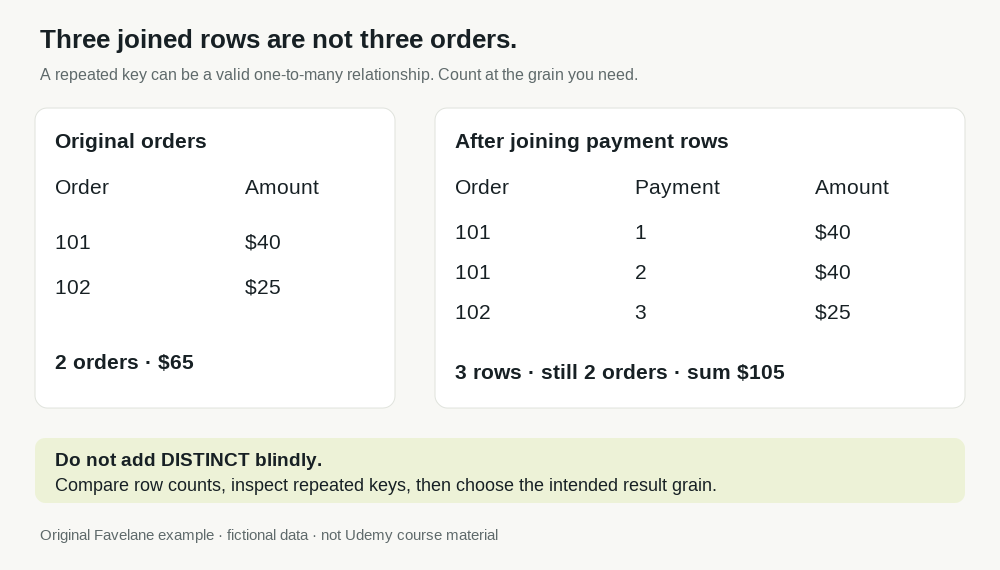
Compare the row counts
SELECT COUNT(*) AS joined_rows,
       COUNT(DISTINCT o.order_id) AS distinct_orders
FROM orders AS o
JOIN payments AS p ON p.order_id = o.order_id;
Expected: joined_rows = 3, distinct_orders = 2. This signals multiple matches for at least one order, but does not prove they are erroneous. Inspect the intended relationship and business rule. Find the repeated key with:
SELECT o.order_id, COUNT(*) AS matches
FROM orders AS o
JOIN payments AS p ON p.order_id = o.order_id
GROUP BY o.order_id
HAVING COUNT(*) > 1;
If you need one row per order, decide which payment definition applies or aggregate payments to one row per order before joining. DISTINCT can hide duplicate-looking rows without correcting an incorrect relationship or total. PostgreSQL’s documentation explains that joins pair rows that satisfy the join condition.
Does the bootcamp fit?
The official Udemy listing showed 8h 51m, 12 sections and 83 lectures on Oct 4, 2026. Its beginner PostgreSQL path includes SELECT, aggregation, GROUP BY, joins, advanced commands, database/table creation and assessments. That may suit someone learning several fundamentals with time to practice. It is not described as specialized training in join fan-out or production debugging.
If this single diagnostic is all you need today, try it and check your schema/business definitions first. Consider the course only if the broader path matches your learning goals. The page showed a last-update date of Dec 2022, so check installation compatibility.
- 1
A beginner SQL path for analysts who need to query, group and join real tables.
Image: Official Udemy course image, affiliate promotional use The Complete SQL Bootcamp: Go from Zero to Hero
Price varies; check the live Udemy listing and checkout before buying. checked 2026-10-09
A broad English-language beginner SQL course by Jose Portilla / Pierian Training, using PostgreSQL and pgAdmin. Its syllabus moves from setup and core queries into grouping, joins, subqueries and database objects. That makes it a plausible structured starting point for several recurring SQL tasks, not a specialized course on diagnosing duplicate join rows.
Buy the SQL bootcamp on Udemy ↗Pros- The syllabus goes beyond isolated SELECT examples into grouping and several basic join types, which suits a learner facing a mix of everyday query tasks.
- At nine hours with 83 lectures, it offers a bounded, guided introduction rather than an unstructured collection of search results.
- The course page's large rating sample and recent review activity are useful interest signals, while still not proving a particular learner's outcome.
Cons- Updated Dec 2022. One recent reviewer reported old PostgreSQL setup/loading trouble; check installation-version compatibility.
- It is broad beginner training, not a focused lesson on join cardinality, duplicate-looking rows or production database debugging.
- The displayed US list price may differ from the price, discount or currency shown at checkout.
What reviews repeat- Recent visible feedback praised clear setup and a useful SQL introduction.
- One one-star reviewer reported old PostgreSQL setup/loading trouble; not proof of a recurring defect.
- Reviewer countries were not shown. This is global feedback, not US-only.
- Best for
- SQL beginners with recurring filtering, grouping and basic join tasks who want guided lessons and time to practise.
- Skip if
- One urgent query fix, advanced SQL tuning, or learners needing a current-version installation course without checking compatibility.
- Official Udemy page showed 8h 51m, 12 sections and 83 lectures on 2026-10-04.
- Listed topics include PostgreSQL/pgAdmin setup, SELECT, aggregates, GROUP BY, joins, advanced queries, tables and constraints.
- The page lists no prior technical experience as required and includes Windows/macOS setup lessons.
- Official page showed 4.6/5 from 258,534 ratings on 2026-10-04; last updated 12/2022.
Price varies; check the live Udemy listing and checkout before buying. · Checked 2026-10-09
Buy the SQL bootcamp on Udemy ↗
Before enrolling
Check the live outline, current price and PostgreSQL setup requirements; preview a lesson to see if the teaching style works for you. Course completion does not guarantee a job, faster work, or a correct production query.
These toy tables and queries are original examples, not copied course footage. If you buy through the link, Favelane may earn a commission at no extra cost to you.