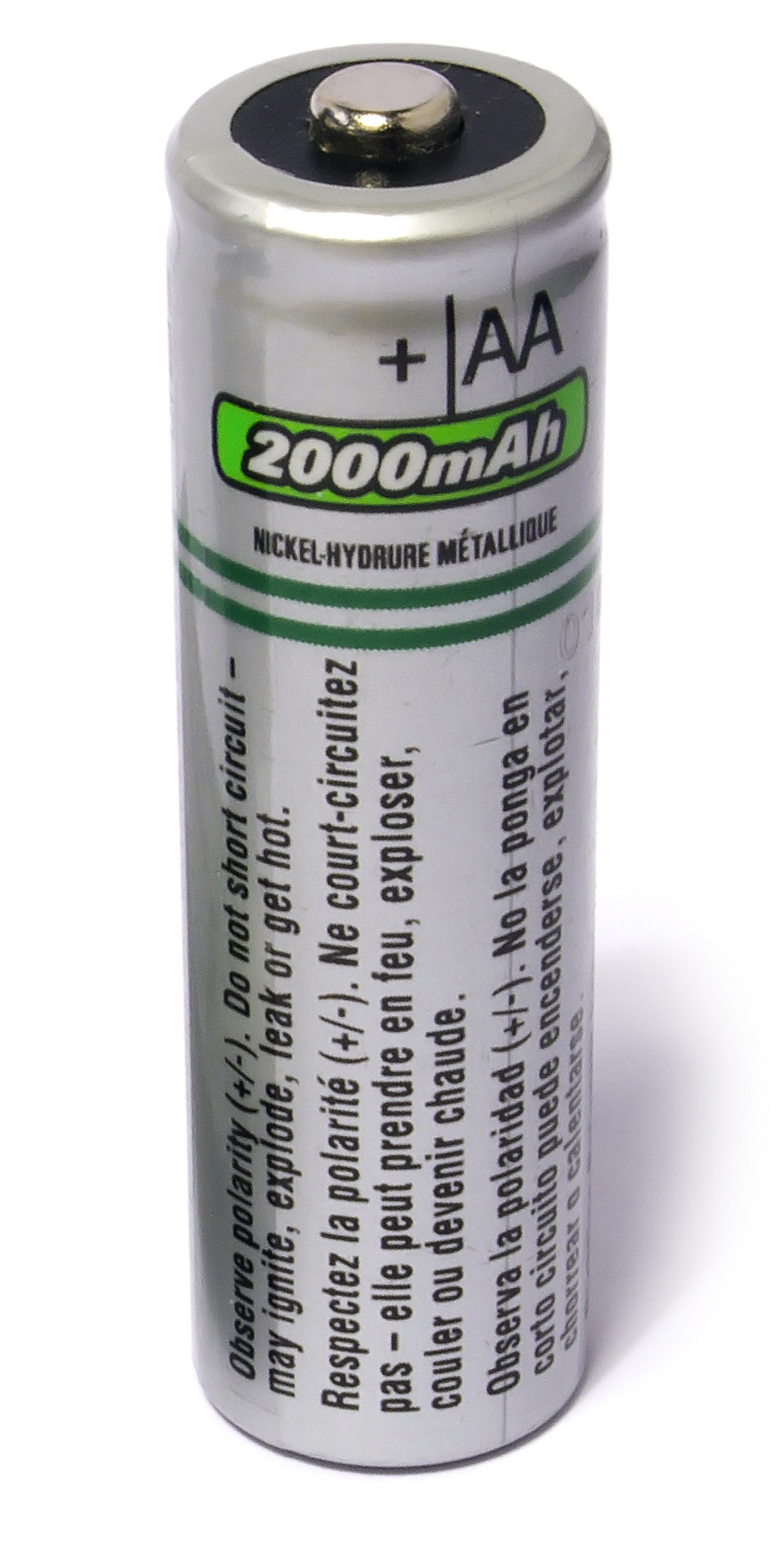
A rechargeable AA battery labeled 1.2V is not, on that evidence alone, undercharged. For a nickel-metal hydride (NiMH) cell, about 1.2V is its nominal voltage—a characteristic of its chemistry, not a readout of how full it is. The familiar 1.5V figure on an alkaline AA refers to a different chemistry.
Before deciding that a battery is faulty or buying a replacement, check two things: whether your device permits that battery chemistry, and whether your charger is intended for it. “AA” by itself does not answer either question.
The label contains different kinds of information
| Marking | What it tells you | What it does not establish | What to check next |
|---|---|---|---|
| AA | A battery size designation | That every AA chemistry is suitable for your device | The device manual’s allowed size and battery types |
| NiMH or alkaline | The battery’s chemistry | That two same-size cells have the same electrical characteristics or charging requirements | Whether the device permits the chemistry, and whether the cell is rechargeable |
| V | A voltage specification; 1.2V on a typical NiMH label is nominal voltage | A live charge percentage, or proof that a cell is defective | The battery and charger instructions rather than treating the printed number as a charge test |
| mAh | Charge capacity | A guaranteed number of hours in your device | The stated test conditions and the device’s requirements; actual use varies |
A label is a starting point for identifying a cell. It is not a compatibility certificate or a battery-health report.
Why 1.2V and 1.5V can both be normal
Panasonic’s current eneloop FAQ describes about 1.2V for its rechargeable NiMH batteries and about 1.5V for alkaline batteries. Energizer’s older rechargeable-battery FAQ explains the same general distinction in terms of electrochemical systems.
That difference is why comparing the two printed numbers is not a useful way to decide whether the NiMH cell finished charging. It also does not mean a NiMH battery will work in every device that takes an AA alkaline battery.
Panasonic’s eneloop FAQ discusses device exceptions, including manuals that exclude NiMH batteries and issues with physical contact or fit. Read those conditions as guidance for that product range, not a universal guarantee for every NiMH cell.
Panasonic also lists waterproof devices, such as underwater lights, as unsuitable for eneloop. It warns that an over-discharged battery can generate flammable gas, creating a risk of the device exploding. Do not use eneloop in those waterproof devices. This is the manufacturer’s specific exclusion for eneloop; check the exact battery maker’s restrictions for other products.
A low-battery indicator needs context
Panasonic also notes that the voltage difference can affect a device’s remaining-charge indication when using eneloop. If your device reports a low battery, check whether its manual discusses rechargeable batteries and their indicators.
Do not automatically dismiss the warning, and do not automatically declare the battery defective. Establish whether the battery type is supported, then use the battery, charger, and device makers’ instructions to assess the situation.
Energizer’s FAQ makes a related point: a simple open-circuit voltage reading is not a reliable standalone verdict on whether a NiMH battery is good or defective. This guide does not provide a battery-testing procedure or tell you to keep charging until a NiMH cell reaches an alkaline label’s number.
mAh is not a promise of hours
The mAh figure describes charge capacity. It does not, by itself, tell you how long a remote, camera, toy, or other device will run.
Panasonic describes a current-times-hours calculation as a guideline, while actual runtime depends on the device and conditions. Without matching test conditions, a capacity number is not enough to promise a runtime or a saving. No runtime comparison is needed to answer the original question: the 1.2V label is not evidence that the battery is only partly charged.
Check the device and charger before changing batteries
- Read the device’s battery instructions. Confirm the permitted size and chemistry. If the manual excludes NiMH, do not use the same AA shape as a reason to disregard it.
- Identify the exact cell and charger. Confirm that the cell is rechargeable and that the charger’s instructions cover its chemistry and size. Do not put nonrechargeable alkaline, heavy-duty, or lithium cells into a charger.
- Follow the instructions for using a set of cells. Panasonic cautions against mixing battery types, brands, capacities, or ages. Do not combine dry cells with eneloop unless the device manufacturer explicitly permits that combination.
- Resolve an unclear specification before replacing the set. Give the device maker the device model, battery chemistry, and exact battery model. Ask whether that combination is supported and whether its battery indicator has any relevant limitations.
The useful next step is to match the instructions—not to look for a rechargeable cell with a bigger printed voltage number. This article recommends no battery, charger, seller, or purchase link.
Sources and photo
The main reference is the current Panasonic eneloop FAQ, checked October 25, 2026. Its product-specific compatibility and indicator statements are kept specific to eneloop.
The Energizer rechargeable-battery FAQ is a 2009 document. It is used only for the stable chemistry distinction, the limits of a standalone voltage reading, capacity terminology, and the warning against charging nonrechargeable cells—not for current product specifications, prices, cycle life, or runtime.
The reference photo is a historical label example. Wikimedia Commons dates the file January 14, 2020; the actual capture date is unconfirmed. It shows AA, NiMH chemistry, and 2000mAh, but does not show a 1.2V marking. The number on this pictured cell is not a recommendation, a current product specification, or evidence of its present capacity.
Photo by Multicherry: NiMH rechargeable AA battery (no visible branding), CC BY-SA 4.0. Favelane uses the downloaded image unchanged and uncropped. The Commons source describes it as derived from the author’s four-cell image. Adaptations of this licensed image must retain compatible ShareAlike terms; no additional restrictions or endorsement are implied.